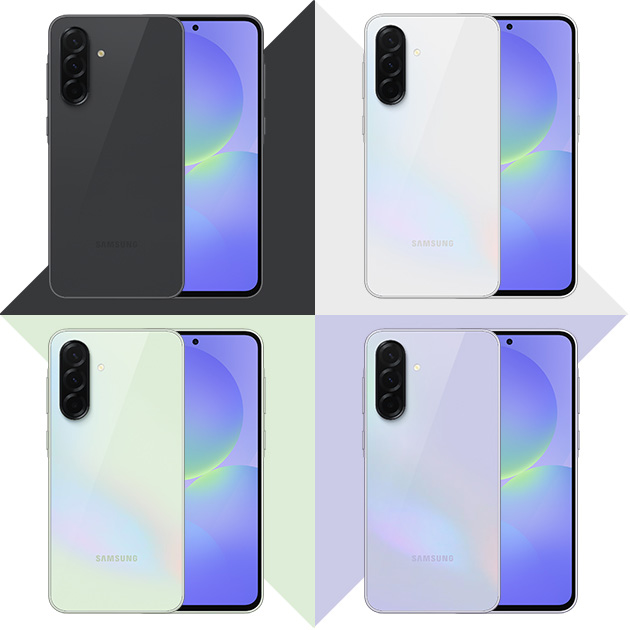
More beautiful and comfortable to hold than before! This was the first feeling I got when I held the Galaxy A36. It feels like Samsung designed and built this phone from scratch. Instead of having the cameras placed one by one on the back, they are now in a sleek island, and this brings two benefits.
First, the back design is much more catchy and attractive, and second, the issue of dust getting between the cameras is gone. Although, this frame covering the cameras unfortunately has a gap from the body, just like the Galaxy S25 Ultra, which causes dust to get into that seam.
The camera island protrusion is quite a lot, and if you put the phone on a table, it wobbles. But in daily use, it won’t bother you at all because it doesn’t get in your way.
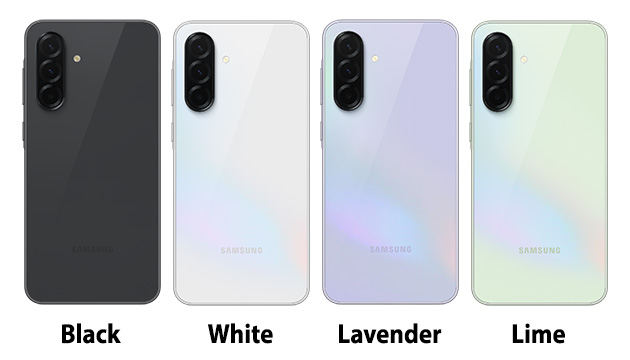
At first glance, the plastic frame looks flat, but when you look closely, you see the edges are even softer than the previous generation. This, along with the 7.4mm thickness which is 0.8mm less than the previous generation, makes the Galaxy A36 much more comfortable to hold than the A35.
There is nothing on the left side of the frame. The right side is where the power and volume buttons are located. The power button placement is good, but the volume buttons are placed way too high, making them hard to reach. At the bottom, there is the speaker, Type-C port, SIM tray, and microphone, and there is another microphone at the top.
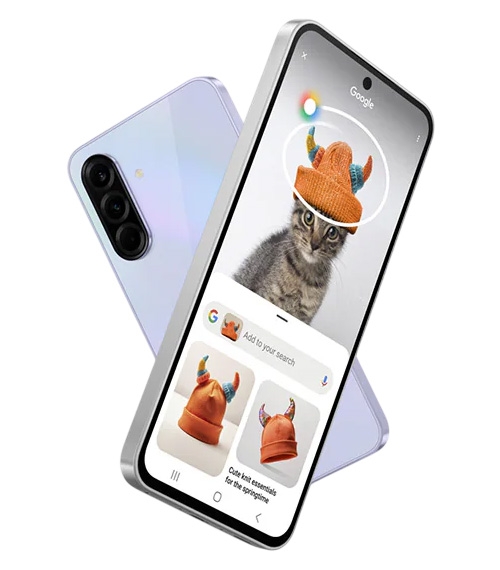
On the front, Samsung used Gorilla Glass Victus+ to protect the screen. The flat display is a double-edged sword. The pro is that screen protectors are easily installed on it, and the con is that swiping on it is hard. In this part, what might disappoint you are the thick screen bezels, though I think you’ll get used to them after a while. The selfie camera is in a hole punch up there, as always.

Positioning the fingerprint sensor under the display. Its placement isn’t great, but since the phone has good weight distribution, you won’t be bothered while using it. Its performance is also slow, which is a weakness for a phone at this price.
You can get the Galaxy A36 in four colors: black, white, lavender, and lime. At 195g, it’s 14 grams lighter than the previous model. It’s also got an IP67 rating, which means it’s totally dustproof and can handle being in up to 1.5 meters of water for half an hour.
Alright guys, I really love the Galaxy A36’s design. I think it falls into the beautiful phones category, and the materials used are also good for its class.
Display

Samsung used a 6.7-inch Super AMOLED panel in the Galaxy A36. This is a 120Hz panel giving you 385ppi, and according to Samsung, its peak brightness is 1900 nits. But how is the real-world performance of this screen?
Looking at the color settings, you’ll find two options: Vivid and Natural. The Vivid mode, which is on by default, gives you much more settings. For my review, I put the screen on Natural mode and checked the color accuracy. After reviewing 24 reference colors, I noticed that in Natural mode, the screen doesn’t produce grayscale tones well, and these colors lean towards blue. In Vivid mode, the situation gets even worse, and the blue tint is more noticeable. In the other 18 colors, the screen’s performance is much better, and the color deviation from reality is lower.
In the refresh rate settings, there is an Adaptive option that switches the refresh rate between 60 and 120Hz, and a Standard option that locks the refresh rate at 60Hz. A positive point in this phone’s refresh rate control is that when you run certain apps like Instagram and YouTube, the refresh rate doesn’t drop to 60Hz to ruin the scrolling smoothness.
Now it’s time for brightness. I tested the Galaxy A36’s screen brightness in four scenarios. The first scenario was when I turned off the ambient light sensor, played SDR content, and maxed out the brightness. In this state, the screen brightness reached 483 nits, which is a normal number. Now in the exact same conditions, when I played HDR content, the brightness hit 1097 nits.
But when I turned on the ambient light sensor and stood under direct sunlight, while playing SDR content the brightness reached 1197 nits, and while playing HDR content it reached 1132 nits, which is a bit weird. Usually, under sunlight and playing HDR content, the brightness should be higher! I can say that the screen generally has good brightness and won’t bother you under the sun.
The screen brightness control on this phone is PWM, and Samsung hasn’t said anything about its flicker rate. In my tests, I found out that this screen has thick, bold, and a lot of flickers, which means if you have sensitive eyes, you’ll definitely be bothered during long usage sessions with this phone. Of course, since these flickers have a somewhat constant frequency, it’s possible that some people with less sensitive eyes won’t be bothered during long sessions.
Alright guys, I can say that the Galaxy A36’s screen is pretty much the same as the A35’s screen, with the difference that its brightness under sunlight has slightly increased. Overall, its screen is good for its price range, but it’s not the best.
Battery & Charger
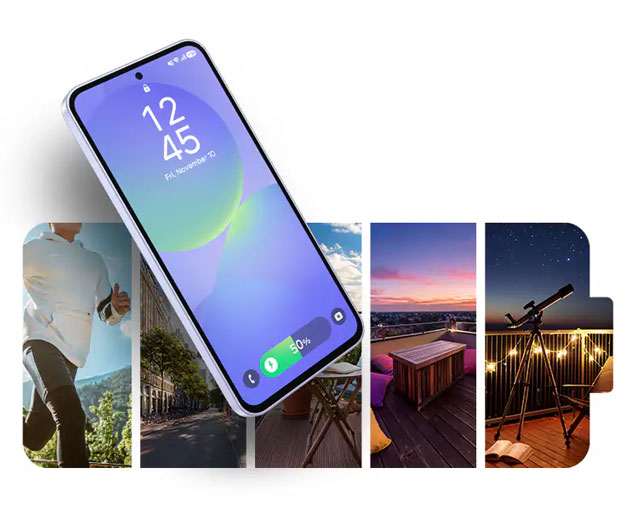
As you know, the charger isn’t in the box. Samsung put a 5000mAh battery in the Galaxy A36, which I think is a disappointing capacity because its competitors are using high capacity silicon-carbon batteries. What’s even worse is that the Galaxy A37 introduced this year doesn’t have a silicon-carbon battery either.
For charging, the A36 has had an upgrade compared to its previous generation, which is that it supports a 45W charger.
In my semi-heavy three-hour test, one hour of Call of Duty at 60fps with high graphics took 26%, one hour of watching YouTube videos took 6%, and one hour of web browsing took 12%, making it a total of a 44% battery drop. Keep in mind guys, I did this test on Wi-Fi, and if I put a SIM card in and test it with mobile data, it will consume even more!
Processor
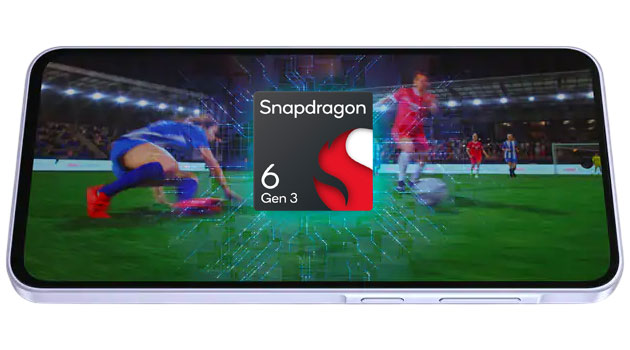
Samsung used a Snapdragon 6 Gen 3 in the Galaxy A36. It’s a chipset that might disappoint you a bit when you read its specs on paper. This chip has downgraded in some aspects compared to older generation chipsets like the Snapdragon 778G. For example, when you look at the GPU specs, you see its processing power is lower than the 778G.
This phone is totally smooth in daily use and won’t bother you. I can just say that it has weaker performance compared to its rivals, especially Xiaomi.
Camera
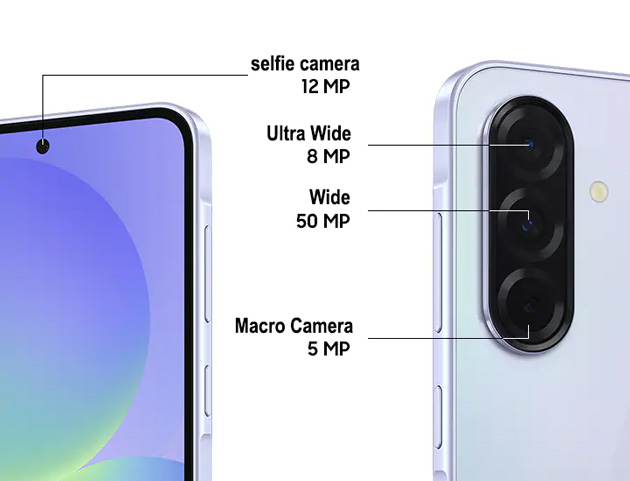
Samsung placed three cameras on the back of the Galaxy A36: main, ultrawide, and macro.
The main camera has a 50MP Sony IMX882 sensor. The lens used for this camera has a 25mm focal length with an f/1.8 aperture. Focusing on this camera is done using PDAF technology, and it supports optical image stabilization.
The ultrawide camera has an 8MP sensor with an f/2.2 aperture and a 16mm focal length. This camera doesn’t support autofocus, which is normal for this class.
The macro camera has a 5MP sensor with an f/2.4 aperture. It can show your subject clearly from a distance of 3 to 5 centimeters and doesn’t support autofocus.
Up front, the selfie has a 12MP sensor with an f/2.2 aperture and a 25mm focal length. Alright, those were the camera specs, now let’s talk about their output.

In natural daylight, photos from the main camera, in normal mode and 2x full-resolution zoom, are captured very beautifully. The colors in these photos are very close to reality most of the time. The white balance in 80% of the photos I took was very accurate, meaning the software does a great job of choosing the white balance values.
Impressively, the dynamic range of the main camera’s photos is truly excellent for this price range. I’m not saying there’s no clipping in the bright and dark areas. There is clipping, but it’s minimal. When I cropped the photos from this camera, I noticed that in normal mode, the detail level is such that if your subject is large and close, the clarity is good, but if it’s small or far away, the edges get blurry.
In 2x zoom, if you don’t crop the photos, you get great details, but if you do, the photos look like Oil-painting effect. In full-resolution mode, the situation is like normal mode, meaning if your subject is close and large, it has good details, but if it’s far, it gets blurry.
Unfortunately, the ultrawide camera struggles significantly with white balance and can only choose the parameters correctly when the lighting conditions are ideal. I took 7 photos with this camera, and 6 out of the 7 photos had either a yellow or blue tint. This tells me that the ultrawide camera usually messes up the white balance. The dynamic range in this camera’s photos is still excellent, and their histogram has a balanced distribution.
When I cropped the photos from this camera, I liked its detail level for an 8MP camera.
Portrait photos on the Galaxy A36 are taken with the main camera and only in 1x mode, which isn’t that appealing. Portraits taken with the main camera aren’t great due to the use of a wide lens, but nevertheless, the colors in these photos are largely natural, the subject is separated from the background with few errors, and the dynamic range is fantastic.
Even though taking photos with the macro camera is a bit hard, if your hand doesn’t shake and the ambient light is good, it gives you an output beyond acceptable. These photos have good details even after cropping, and you can count on them in good lighting conditions.

Selfie camera is, in a word, magnificent. This camera takes photos so good that I can boldly say it’s better than many Android flagships! The colors in these photos are natural, their dynamic range is excellent, and the detail level is just awesome. Alright, that was the daylight performance which I was very satisfied with, and I think overall it takes better daytime photos than its Xiaomi peers.
Now it’s time for night photos. The main camera’s night performance is literally fantastic. When I say fantastic, I mean it can easily compete with more expensive phones in all factors like white balance, color accuracy, and detail level. The brightness level in these photos is excellent, colors are extremely natural, and there’s absolutely no noise.
When I cropped the night photos from this camera, I realized that in normal mode, the details are so good that you can’t find any flaws. In a 100% crop, there is a little noise in limited areas, but the details are so good that you can ignore the noise.
By activating night mode, the camera very smartly chooses the settings, and by lowering the ISO and shutter speed, it takes a photo for you that you’ll enjoy looking at. In manual settings, this camera still maintains its fantastic performance, and with the slightest change in parameters, your photo changes drastically. It’s very surprising to me that the Galaxy A36 is a mid-range phone, but its main camera doesn’t rely heavily on ISO at all!
Ultrawide camera photos at night are such that if the ambient light is good, the colors are extremely excellent and the brightness level is captured well. But if the ambient light is low, the output isn’t good. As for its clarity, I have to say don’t count on it at night. But overall, its output is fine for viewing on the phone itself.

Portrait photos in low light have mostly natural colors and the subject is separated from the background with few errors, but overall they aren’t very good because the textures look blurry.
The Galaxy A36 can shoot 4K 30fps videos with its main camera. These videos have acceptable clarity, the colors are largely natural, and the dynamic range is good too. Autofocus performance isn’t that interesting, and the subject has to cover a large part of the frame for the camera to find it. Of course, you can’t expect more than this from a phone in this price range. Stabilization performance in natural daylight is truly excellent and removes a lot of the video shakes for you.
Ultrawide camera videos are recorded at 1080p with 30fps, which are not good at all and have nothing to praise. White balance in these videos isn’t accurate, the dynamic range is terrible, the clarity is bad, and let’s just drop it and not talk about it to save our time.
Selfie camera videos are recorded at 4K 30fps. The clarity of these videos is amazing, to the point that even if you watch them on a TV, the clarity is very good. Colors are largely natural, although if the sunlight is harsh, they sometimes mess up and get a yellow tint. Stabilization isn’t done well in this video either, but the dynamic range is fantastic in normal mode.